Why Agentic Commerce Is Becoming the Next FinTech Battleground
Tell an AI assistant to find and book the best flight under $500, and watch what happens next — no tab-hopping, no comparing prices by hand, no typing in a card number. The assistant just checks, picks, and pays.
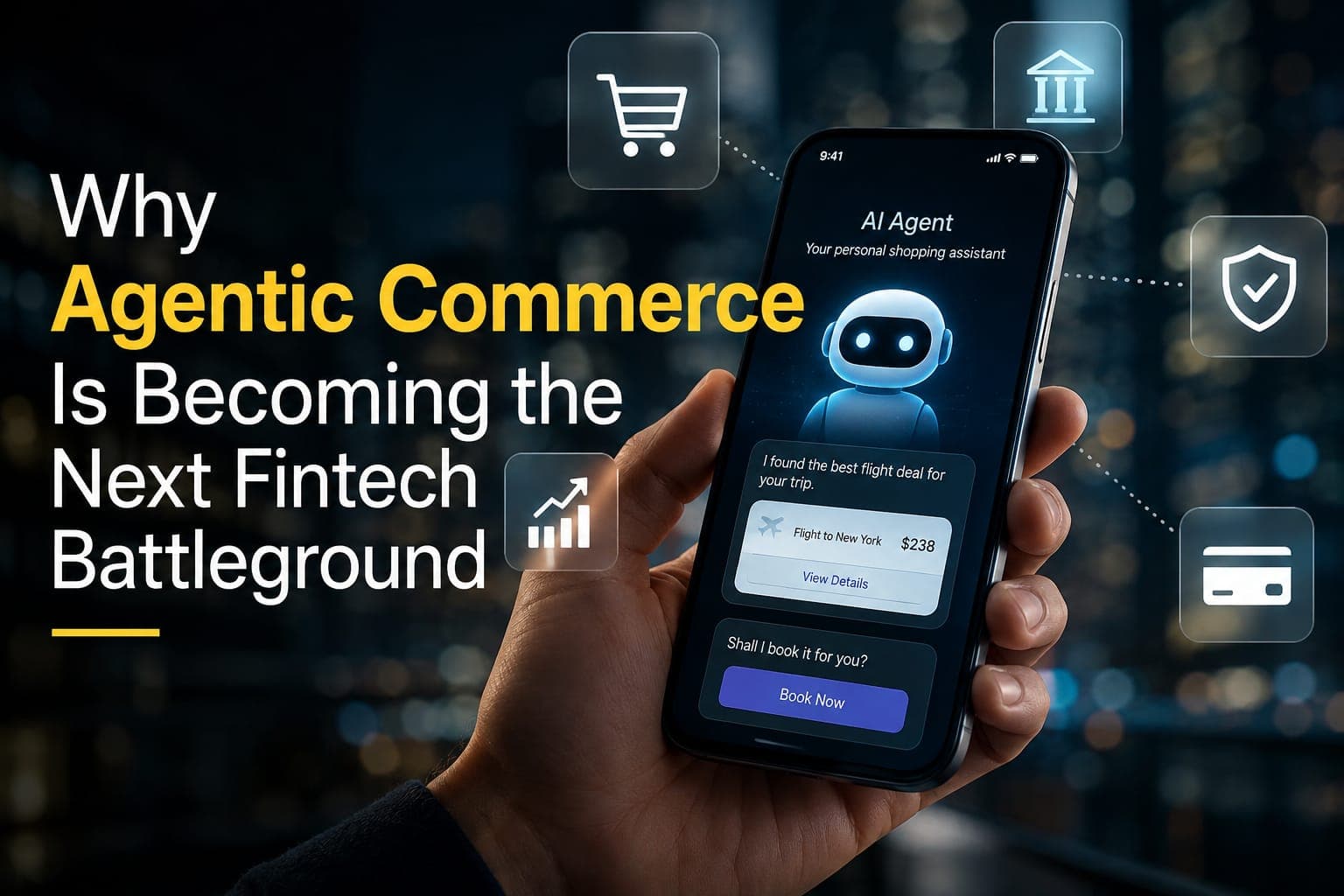
That is agentic commerce, and it is turning into one of the sharpest fights in fintech right now. Banks, card networks, and the big AI labs all want a piece of it. They are all racing to own what happens the moment an agent, not a person, hits "pay."
What Is Agentic Commerce?
Agentic commerce means letting an AI agent shop for you — not just suggest things, but actually decide and buy on your behalf. There is a real gap between the two. A regular assistant says: "Here are five laptops you might like." An agentic one goes further: "I checked your budget, compared prices, and bought the best one — with your okay."
That word "bought" is the whole story. Three parties make this work: the agent shopping, the merchant selling, and the payment provider moving the money. Once you see how those three connect, the rest of this gets much easier to follow.
How Does Agentic Commerce Actually Work?
Strip it down and it is really four steps. You tell the agent what you want — say, a hotel in Paris under $200 a night. It compares options: price, reviews, location, whatever matters to you. It picks the one that fits best. Then it pays. That last step is where fintech comes in.
Paying on someone else's behalf is not simple. The agent has to prove it is really acting for you. It needs permission to spend your money. It has to process the payment, keep your card details safe, and sort out refunds if the booking falls through. Nobody has cracked all of that cleanly yet — which is exactly why so much money is pouring into this space.
Why Is Agentic Commerce a Big Deal for FinTech?
Here is the part that should grab anyone in payments: checkout might just disappear. No carts, no forms. You describe what you want, and an agent handles the rest. That flips who starts a purchase. Right now, you click "buy." In an agentic world, the agent can trigger the transaction on its own — it is just acting on something you told it earlier, no click required.
So payment companies now have to build for a customer that is not human. That means confirming identity, capping how much an agent can spend, and checking it is doing what you actually asked. And the fight is not only about processing payments anymore — it is about who owns the assistant people are talking to in the first place. Control that, and you shape where people shop and who gets paid. That is the real reason banks, card networks, and tech companies are all piling into this at once.
Who Is Competing for Agentic Commerce?
A few different players are jostling for position. AI companies are building the agents themselves. Payment networks are figuring out how to move the money behind them. Banks and fintechs sit underneath, holding the actual accounts. E-commerce platforms want to be the bridge between agents and merchants. Merchants, meanwhile, are scrambling to make sure their products even show up when an agent goes looking.
The moves so far show how seriously everyone is taking this. Visa struck a deal with OpenAI in 2026 to bring tokenized payments straight into ChatGPT, with spending limits and merchant controls built in. Mastercard rolled out Agent Pay for Machines, built for AI agents paying each other automatically — including fractions of a cent, settled across cards, bank accounts, and stablecoins. Google took a different route with an open protocol called AP2. Stripe, meanwhile, built a toolkit that plugs agents straight into its existing payment infrastructure.
None of this is a side project. AI, payments, banking, and e-commerce are colliding in the same place. Every major player wants to be standing at the center of it.
What Could Go Wrong?
Handing an AI your payment method sounds simple, until you actually think it through. What if the agent misreads what you asked for and buys the wrong thing? Could someone trick an agent into approving a purchase it should not? How much of your financial data should it even have access to? And when a payment company sees a transaction come through, how do they know it is really you behind it?
There is also the question nobody loves answering: if something goes sideways, who is on the hook — the AI company, the bank, the payment provider, or the merchant? Right now, that is genuinely unresolved. It is exactly why every major payments player is racing to build guardrails before this scales any further.
Is Agentic Commerce the Future of Payments?
Nobody can honestly say agentic commerce will wipe out normal shopping. The tech, and more importantly the trust behind it, still has a long way to go. Right now, buying something looks like this: website or app, cart, checkout. The version being built looks more like this: tell an agent, it finds a merchant, it pays.
If that second version becomes how most people shop, the middleman changes. Whoever connects the AI, the merchant, and the payment rail gets a lot of say over how commerce works from here.


