AI in Drug Discovery and Development: From Lab to Market
From early-stage research to market launch, artificial intelligence is reshaping every stage of how new medicines are discovered, tested, and brought to patients.
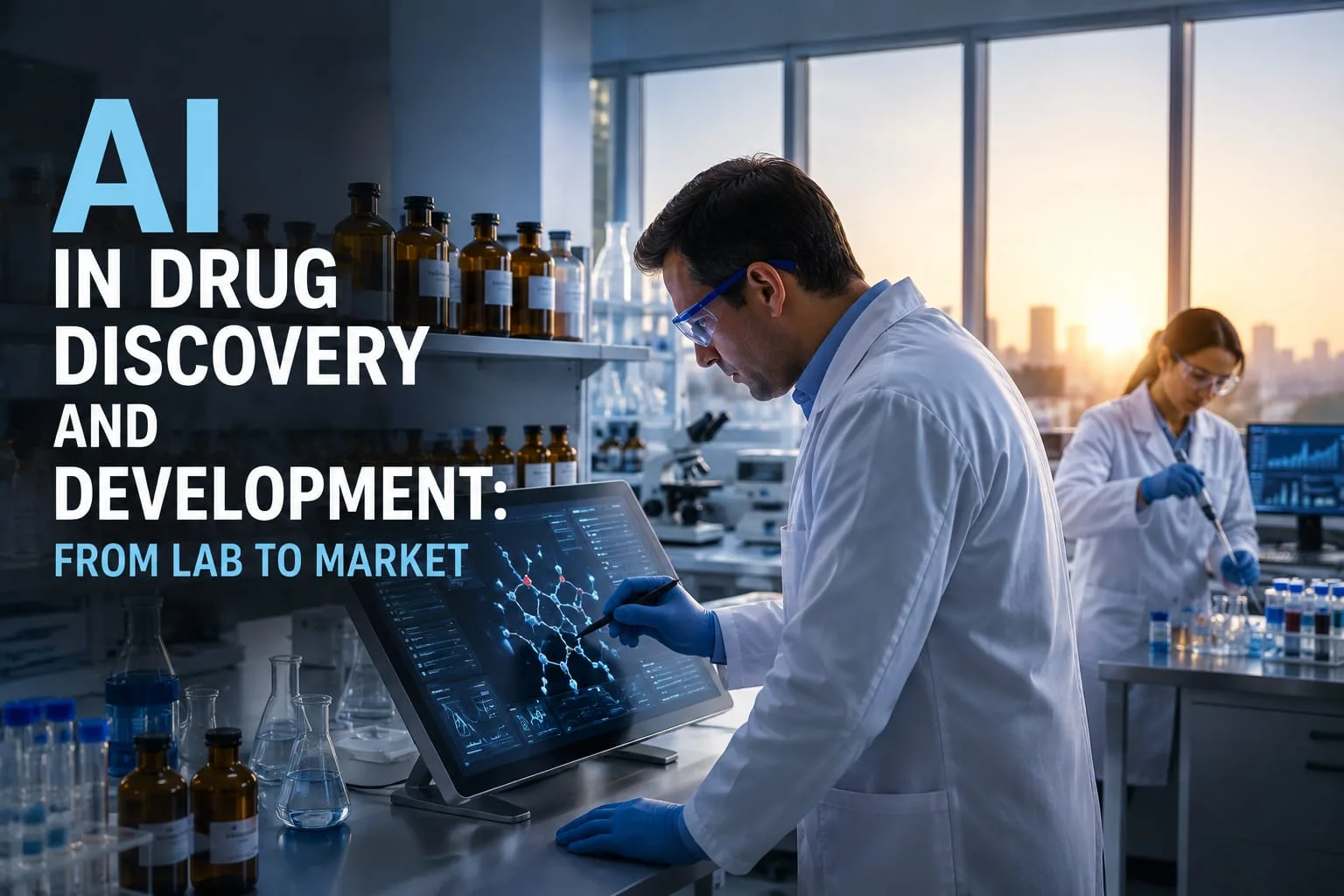
AI is revolutionizing drug discovery and drug development within the pharmaceutical industry. AI in drug discovery accelerates the analysis of vast amounts of data, pinpointing viable drug targets, creating molecules, and choosing the most promising ones for research.
However, AI's use is not limited to the laboratory. It can also facilitate clinical development, regulatory review and other phases that a medicine has to go through before it is available in the market. This article traces that full journey, from early research to market launch.
How AI Is Changing Drug Discovery
Previously, scientists would have to test thousands, and sometimes millions, of substances to identify a single product that showed potential. This required years of effort and enormous budgets, and many of the compounds that were developed failed along the way. AI drug discovery tools are changing this. AI can identify potential drug targets that could be overlooked by researchers in large data sets. It can also speed the process of drug screening by scanning far more compounds than manual lab testing can, helping researchers focus on promising compounds.
AI can also help in molecule design, by generating new chemical structures that have desirable properties, and predict the behavior of molecules before they are even put on a laboratory bench. New industry statistics indicate that candidates can be screened much quicker using AI as compared to traditional methods. Such AI-powered drug discovery is not a substitute for laboratory work, but it significantly cuts down the drug discovery process.
From Drug Discovery to Development
Once researchers identify a promising drug candidate, the work of drug development begins. The candidate goes through laboratory testing to confirm it behaves as expected, followed by safety testing to check for toxicity risks. It is also important that scientists understand the action of the drug in the body before they can proceed. In this phase, AI can be used to anticipate potential side effects and rank candidates for further consideration, allowing teams to advance the most promising prospects. It is also the place where teams start preparation for clinical trials, such as the design of study protocols.
It's important to note that while AI in drug development can significantly speed up the process and enhance predictions, it cannot entirely replace laboratory experiments. As in the pharmaceutical industry, every insight generated from AI must be backed by lab data.
AI in Clinical Trials
Once a candidate enters clinical development, AI in clinical trials continues to help. Finding suitable patients has long been one of the slowest parts of trial planning. AI can quickly identify patients that may be eligible for trials by searching health records compared to manual screening. It can also be used to analyze the discoveries of clinical trials as they happen, looking for trends in treatment outcomes for various patients.
In addition to recruitment, AI assists with safety surveillance by detecting early warning indicators during an experiment, and aids in more efficient trial planning by forecasting enrollment periods. These uses of AI in drug development don't change what trials measure, but they help trials run with fewer delays.
From Drug Approval to the Market
Even after successful clinical trials, a medicine must pass regulatory review before it can be sold. Health authorities examine safety and efficacy data closely, and this takes time. AI can continue supporting pharmaceutical companies here in practical ways. It helps with data analysis, organizing large regulatory submissions for consistency. It supports ongoing safety monitoring after drug approval, scanning real-world reports for early warning signs.
AI is increasingly being used in manufacturing to forecast equipment failures and in supply planning to help ensure that medicines are available at the pharmacy without shortages. Once on the market, AI assists with post-market monitoring, tracking how a drug performs across large patient groups. Together, these applications show how AI in pharma extends well beyond the lab, supporting drug commercialization across the pharmaceutical industry.
Benefits and Challenges of AI in Drug Discovery
Among the clear benefits of AI in drug discovery, companies can analyze data much faster than manual methods allow and screen far more compounds in the same amount of time. AI reduces time spent on early-stage research, improves drug candidate selection by ranking options based on predicted safety, and supports better decision-making with clearer data.
There are also real challenges of AI in drug discovery. Poor-quality data can skew AI predictions, and every output still needs laboratory validation before it can be trusted. Models can make mistakes, especially where training data is limited. Regulatory expectations around AI use are still evolving, creating uncertainty. Most importantly, AI cannot replace scientific expertise. It works best as a tool supporting experienced researchers, not a substitute for them.
What Does the Future Hold for AI in Pharma?
Looking ahead, generative AI, machine learning, and other AI technologies are likely to become more common across pharmaceutical R&D. Analysts expect the future of AI in drug discovery to include wider use in designing entirely new molecules, not just screening existing ones, with generative AI in drug discovery already being tested for hard-to-treat diseases. The message stays the same: AI is not replacing scientists. It is becoming another tool helping researchers make faster, better-informed decisions.


