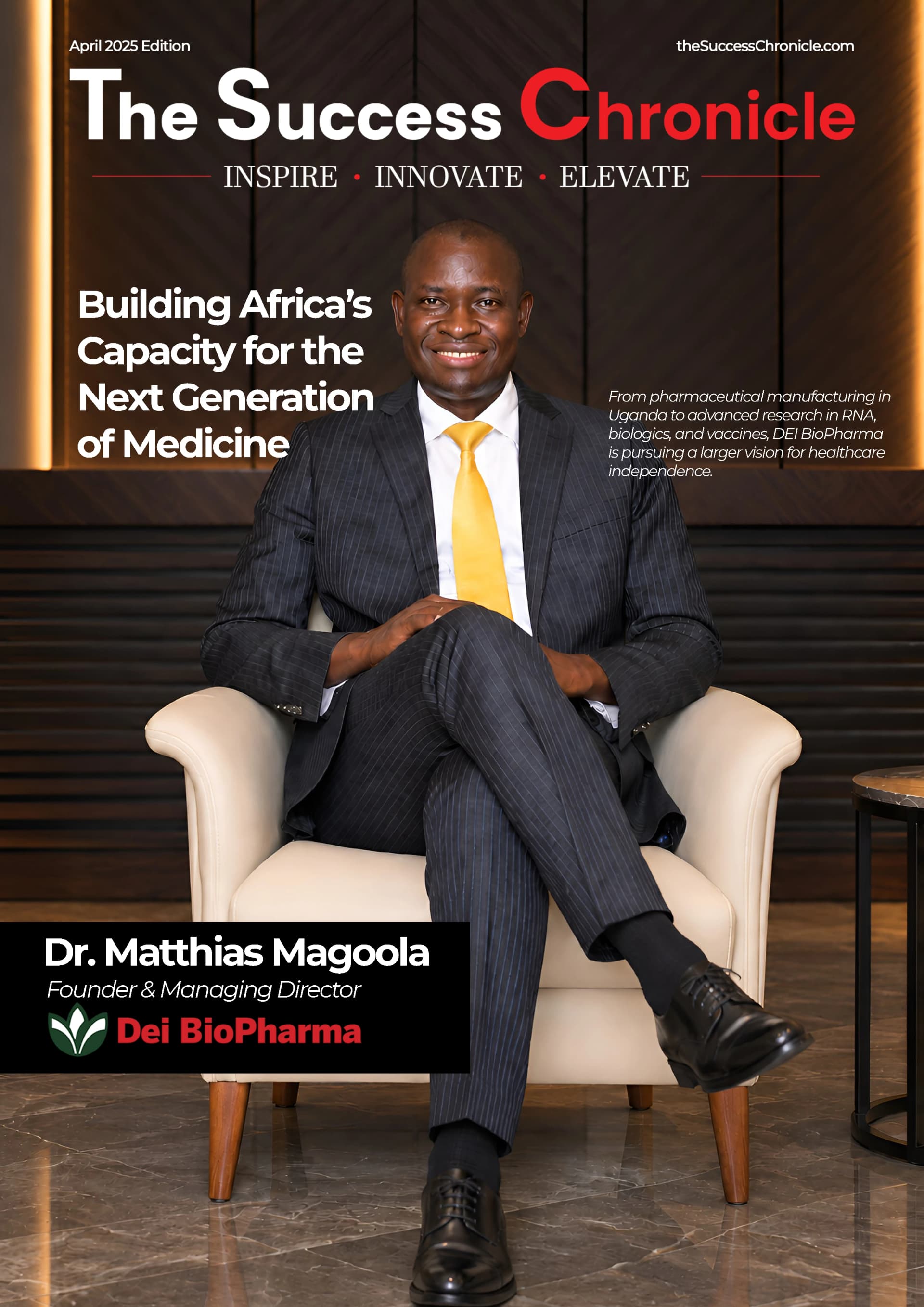
From pharmaceutical manufacturing in Uganda to advanced research in RNA, biologics, and vaccines, DEI BioPharma is pursuing a larger vision for healthcare independence.
Healthcare innovation is often associated with the world's traditional pharmaceutical centers. But an important shift is taking place across Africa: local companies are increasingly looking beyond importing medicines and beginning to build the research, manufacturing, and scientific capabilities needed to create them closer to home.
DEI BioPharma Ltd is pursuing that opportunity from Uganda.
The company describes itself as a biotechnology and pharmaceutical research organization focused on developing and manufacturing medicines and vaccines. Its stated vision is to contribute to a more self-reliant African healthcare system while developing products that can eventually reach international markets.
At the center of that ambition is a large pharmaceutical and biotechnology project in Matugga, Wakiso District, together with research programs spanning biologics, vaccines, oncology, chronic diseases, insulin, and RNA-based technologies.
From Local Ambition to a Larger Healthcare Vision
DEI BioPharma was incorporated in Uganda and operates under the leadership of scientist and entrepreneur Dr. Matthias Magoola, whom the company identifies as its founder.
Magoola's background in science and entrepreneurship has shaped the company's direction toward pharmaceutical research and advanced therapeutic development.
Rather than focusing exclusively on conventional medicines, DEI's stated portfolio extends into areas such as monoclonal antibodies, biologics, vaccines, insulin, oncology treatments, generics, and nutraceuticals.
That breadth reflects a larger objective.
For countries that depend heavily on imported medicines, building domestic pharmaceutical capacity can have implications beyond commercial growth. Local manufacturing can support supply resilience, create technical employment, develop scientific expertise, and reduce dependence on distant supply chains.
DEI BioPharma has positioned its development around that broader opportunity.
A Facility Designed Around Advanced Manufacturing
One of the most significant elements of DEI's strategy is its planned and developing pharmaceutical and biotechnology manufacturing infrastructure in Matugga.
The company describes the project as a major multi-unit facility designed to support the production of medicines and vaccines, with specialized capabilities intended for different areas of pharmaceutical manufacturing. Its website highlights technologies and products ranging from biologics and vaccines to medicines addressing infectious diseases, cancer, and chronic conditions.
The company also states that the facility is being developed to meet stringent international quality expectations, referencing US FDA, European Medicines Agency, and WHO standards.
Such standards are particularly important for a company with ambitions beyond its home market.
Manufacturing for international markets requires more than a modern building. It requires validated processes, quality systems, regulatory discipline, trained personnel, reliable supply chains, and rigorous product development.
That is where DEI's long-term challenge and opportunity meet.
“Healthcare independence begins when innovation, scientific capability, and manufacturing can grow together.”
Research as a Core Capability
Manufacturing is only one side of the company's strategy.
DEI BioPharma also places research at the center of its identity, with work involving RNA technologies, vaccines, biologics, and advanced therapies.
The company says it has filed more than 100 patents with the United States Patent and Trademark Office, covering technologies associated with areas including cancer, HIV, Alzheimer's disease, malaria, tuberculosis, diabetes, and sickle cell disease.
Patent filings, of course, represent intellectual-property claims rather than proof that every resulting therapy is commercially available or clinically established. That distinction is important in pharmaceutical reporting.
Nevertheless, the breadth of the company's stated patent portfolio illustrates the scale of its research ambitions.
In 2025, Dr. Magoola also published research concerning RNA-based cancer vaccines and CAR-T cell immunotherapy in the peer-reviewed journal Cancers, according to DEI's official publication.
For DEI, research is therefore not positioned as an activity separate from manufacturing. It is intended to create a pipeline that can connect scientific ideas with future pharmaceutical products.
The Growing Role of RNA Technology
RNA technology has become one of the most closely watched areas of modern biotechnology.
DEI has identified mRNA as an important part of its research and manufacturing strategy and says its planned capabilities could support production of up to one billion mRNA vaccine doses annually.
The company has also announced work involving RNA-based approaches to infectious diseases and cancer.
In October 2025, DEI reported that Dr. Magoola presented new patent work involving mRNA vaccine concepts for Ebola and Mpox at an Africa CDC-related conference in South Africa. The company described the technology as part of a broader effort to develop African-owned biomedical innovations.
The significance goes beyond any single vaccine.
RNA platforms can potentially be adapted for different medical applications, making the underlying technology strategically important for future outbreak response and advanced therapeutics.
For an African pharmaceutical company, developing expertise in this area could also contribute to a stronger regional scientific ecosystem.
Moving Toward International Markets
DEI's ambitions extend well beyond Uganda.
The company says it intends to expand into African regional markets and ultimately into the United States and Europe. Its published roadmap includes commercial expansion across the East African Community, Southern African Development Community, wider Sub-Saharan Africa, and international markets.
Recent regulatory developments suggest that this international strategy is already being pursued.
In 2025, DEI reported that the U.S. FDA accepted its application for review concerning a generic version of liraglutide. Later that year, the company announced that the FDA had accepted development plans for liraglutide and semaglutide.
In January 2026, DEI reported another FDA milestone: acceptance of its abbreviated new drug application for teriparatide injection, a generic version of Forteo, for substantive review.
These developments do not mean that all of the company's products have received final U.S. marketing approval. Rather, they show the company's efforts to navigate the regulatory pathway required to enter highly regulated international markets.
Making Advanced Medicine More Accessible
Affordability is another recurring theme in DEI's stated mission.
The company says it wants to develop high-quality medicines that are accessible to populations that have historically faced difficulties obtaining advanced treatments. Its focus includes both essential medicines and more complex biological therapies.
That ambition addresses a major challenge in global healthcare.
Scientific breakthroughs have limited impact if patients cannot access them. Manufacturing closer to the markets being served can potentially improve supply reliability and create opportunities to reduce certain costs, although affordability ultimately depends on factors including regulatory requirements, manufacturing economics, distribution, reimbursement, and scale.
DEI's model is therefore built around a difficult but important equation: advanced science must eventually become practical healthcare.
“The real measure of pharmaceutical innovation is not how advanced the science looks, but how effectively it reaches the people who need it.”
Creating an Ecosystem Around Healthcare
DEI's vision also extends beyond medicines.
The company highlights employment creation, sustainability, education, internships, university partnerships, STEM initiatives, and professional training as part of its wider impact.
This approach recognizes that pharmaceutical independence cannot be created through buildings and equipment alone.
It requires scientists, pharmacists, engineers, technicians, regulatory professionals, manufacturing specialists, researchers, and future leaders.
By investing in skills and partnerships, companies can help develop the human infrastructure required to support an expanding life-sciences sector.
For Uganda, that could be particularly significant as the country seeks to strengthen its position within Africa's pharmaceutical and biotechnology landscape.
The Road Ahead
DEI BioPharma is operating at the intersection of several major changes in healthcare: biotechnology, personalized medicine, RNA research, vaccine manufacturing, biologics, regulatory modernization, and the growing demand for affordable treatments.
Its journey is still developing, and many of its most ambitious programs remain dependent on scientific validation, regulatory approvals, manufacturing readiness, financing, and successful commercialization.
But the direction is clear.
DEI is attempting to build more than a pharmaceutical manufacturer. It is developing a model in which research, intellectual property, advanced manufacturing, talent development, and international market access can reinforce one another.
That is an ambitious undertaking for any company—and particularly meaningful in a region where strengthening local healthcare capacity remains a major priority.
A Future Made Closer to Home
The story of DEI BioPharma is ultimately about where the next generation of medicines can come from.
For decades, many African healthcare systems have depended heavily on external pharmaceutical supply. DEI's vision challenges that pattern by pursuing research and manufacturing capabilities from within Uganda while seeking pathways into international markets.
Whether every element of that vision reaches its full potential will depend on science, regulation, investment, partnerships, and execution.
But the underlying idea is powerful: Africa does not have to remain only a market for pharmaceutical innovation; it can increasingly become a place where that innovation is researched, developed, manufactured, and shared with the world.
For DEI BioPharma, that is the future it is working toward—one where African scientific capability becomes an active part of the global healthcare story.
Company at a Glance
Company: DEI BioPharma Ltd
Industry: Pharmaceutical Manufacturing
Headquarters: New York, USA
Year Established: 2022
Founder & Managing Director: Dr. Matthias Magoola
Website: https://www.deibiopharma.com/