The Billion-Dollar EV Battery Recycling Industry
With millions of electric cars hitting the road every day, their batteries will eventually reach the end of their lifespan — turning EV battery recycling from a choice into a financial and environmental necessity.
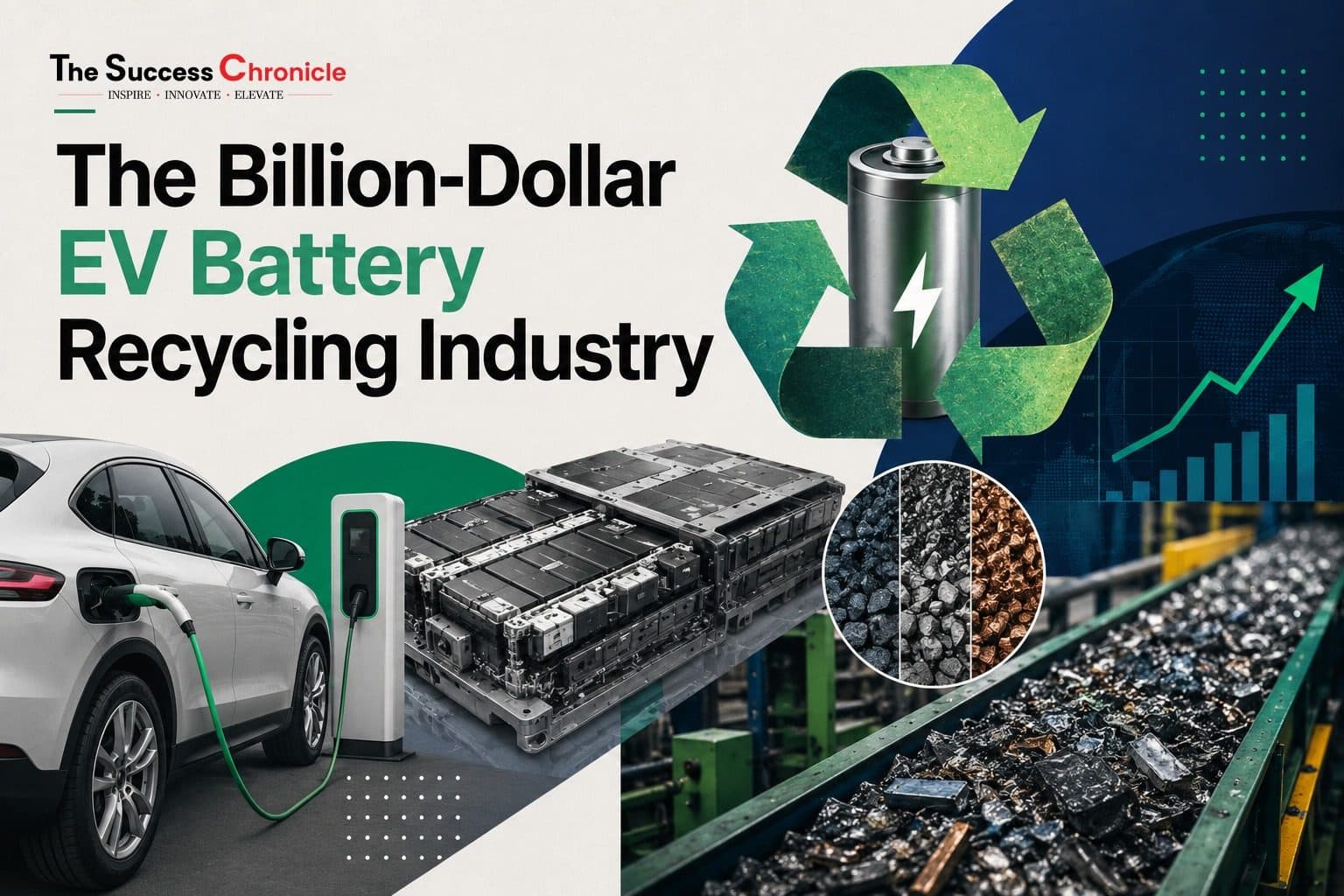
With the increased adoption of electric vehicles, there is a pressing demand for EV battery recycling. With millions of electric cars hitting the road almost every day, batteries will eventually reach the end of their lifespan. Therefore, EV battery recycling is no longer a choice — it has become a financial as well as environmental necessity. In fact, this industry is already worth billions of dollars and is growing further at a rapid pace.
In the current scenario, electric vehicle battery recycling sits at the intersection of sustainability and big business. The weight of a typical EV battery pack is more than 500 kilograms, a mixture of lithium, cobalt, nickel, and manganese. Although these materials have advantages, they are also potentially toxic — meaning that if EV battery waste is not disposed of correctly, it can cause substantial damage to the environment.
According to estimates by experts, more than 11 million metric tons of used EV batteries will need to be recycled by 2030. That number is staggering, and as a result, both government and private industry are investing heavily in solutions.
How to Dispose of EV Batteries the Right Way
How to dispose of EV batteries safely is one of the most-asked questions among EV owners. The answer is pretty simple — never throw them in regular trash. Instead, owners can contact the EV manufacturer, reach out to certified recyclers, or check local regulations.
Most major brands, including Tesla and BMW, have take-back programs. Additionally, many electric battery recycling companies accept old packs directly, and some regions mandate specific drop-off points for EV batteries.
Furthermore, many electric car battery disposal companies now offer doorstep pickup services, making the process even more convenient for vehicle owners.
Companies Recycling EV Batteries
Several major companies are shaping this industry today. Li-Cycle (Canada) is one of the leading EV battery recycling companies globally, using a hydrometallurgical process that recovers up to 95 percent of battery materials. Redwood Materials (USA), founded by former Tesla CTO JB Straubel, focuses on closing the loop for battery supply chains. Umicore (Belgium) is a global leader in recycling batteries from electric vehicles, with decades of experience in materials recovery, while Retriev Technologies (USA) is among the earliest electric car battery disposal companies, handling lithium-ion batteries at scale.
As JB Straubel, CEO of Redwood Materials, puts it: "We can absolutely solve this problem. We have the technology. We need the scale and the urgency."
Case Study: Li-Cycle's Hub-and-Spoke Model
Li-Cycle offers a compelling example of innovation in electric vehicle battery recycling. The company built a two-stage system it calls the "Hub and Spoke" model. Spoke facilities are smaller, regional sites that safely shred and process used EV batteries into a material called "black mass." Hub facilities then take that black mass and extract pure lithium, cobalt, and nickel from it.
In 2023, Li-Cycle opened its Rochester Hub in New York, designed to process 35,000 tonnes of black mass annually — enough to supply recycled lithium for roughly 225,000 new EV batteries each year. This approach drastically reduces the carbon footprint compared to mining new materials.
Li-Cycle's model proves that recycling can be both profitable and scalable. As CEO Ajay Kochhar put it: "Battery recycling is not just an environmental solution — it is a massive economic opportunity."
The Billion-Dollar Opportunity Ahead
The global EV battery recycling market is already worth billions of dollars, and it is estimated to cross USD 40 billion by 2030. This rapid growth is attracting venture capital, government grants, and corporate partnerships alike.
A report by BloombergNEF found that over USD 1.5 billion was invested in battery recycling startups in 2022 alone. Additionally, the US Inflation Reduction Act has unlocked further funding to support domestic recycling of batteries from electric vehicles.
Entrepreneurs in this space are optimistic. As Anil Bhatt of Attero Recycling in India noted: "The battery recycling sector will be one of the most important industries of this decade. We are only getting started."
Final Thought
The growth of electric cars makes the need for smart battery disposal more critical than ever. Fortunately, innovative electric car battery recycling companies are stepping up to meet this challenge — from Li-Cycle's hub model to Redwood's supply chain approach, the solutions are promising.
Whether you are an EV owner, an investor, or a policy maker, this industry deserves your attention. The billion-dollar future of EV battery recycling has already arrived.
Outlook: Beyond the Passenger Car
The electrification wave is extending beyond passenger vehicles into commercial trucks, two-wheelers, aviation, and maritime shipping. Electric semi-trucks from Tesla, Freightliner, and Chinese OEMs are entering fleet deployments. The EV market of 2030 will look dramatically broader than today's passenger-car-dominated picture.


